A robot can now sense a person, interpret spoken instructions, and change its next move without a fixed script for every step. That shift makes the human-machine boundary less about appearance and more about who understands the task, makes the choice, and carries the risk.
Quick read
- Sensors let robots respond to people, objects, and changing spaces.
- Software can turn ordinary speech into machine actions.
- Physical limits still show where the machine stops and human judgment begins.
The body is only one part of the divide
People often judge a robot by its shape. A wheeled platform looks like a tool, while a machine with arms, hands, or a face can seem closer to a person. That visual test misses the harder question: what can the system sense and decide?
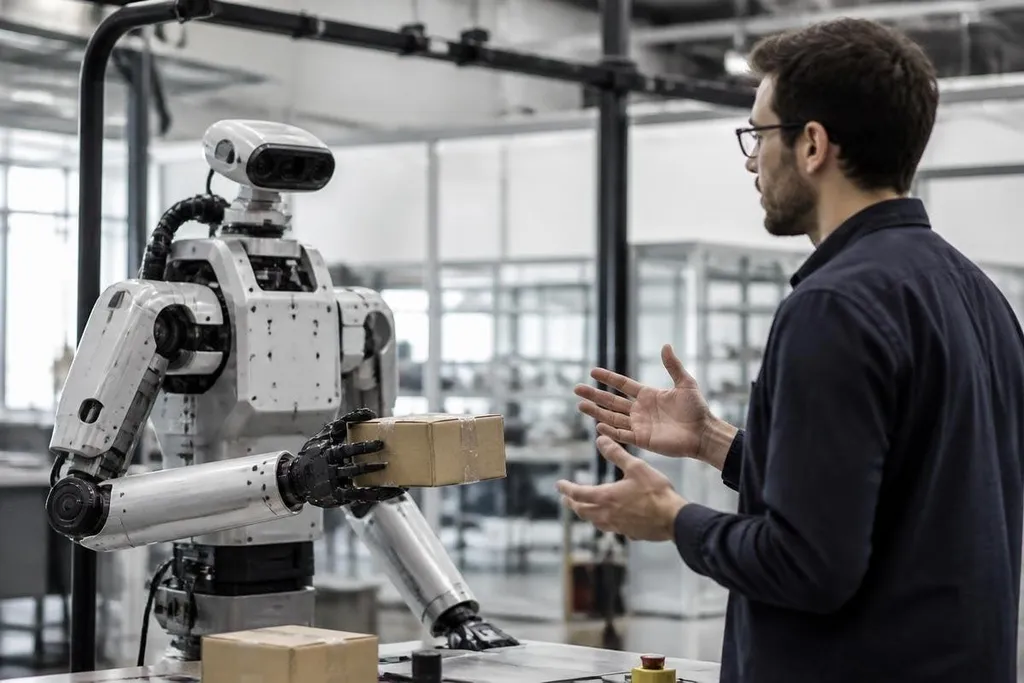
A robot with cameras, microphones, force sensors, and software can connect events over time. It can see an object, hear an instruction, check whether its grip is safe, and change its movement when the object shifts. None of this gives the robot human awareness. It gives the robot a wider set of machine responses.
That difference matters in a factory, hospital, or home. A fixed machine repeats a known motion. A system that reads its surroundings can work near people and handle tasks with more variation, though each new situation adds room for error.
Language makes the gap harder to see
Voice control adds another layer. A person can give a short instruction such as “move that box to the table,” while the robot must connect words to objects, locations, and a safe path. The software has to decide what “that” means and whether the requested action is possible.
The machine may appear to understand the sentence, but its process is different from human thought. It matches language with sensor data, stored patterns, and programmed actions. If the room changes or the instruction lacks detail, the robot may need a new command or a person to take control.
This is why a smooth conversation can create a false sense of trust. A robot may answer quickly while missing the reason behind a request. It can follow the words and still fail the task.
Action is where the boundary matters
The most useful test is not whether a robot sounds human. It is whether the robot can act safely when conditions change. A machine that picks one object from a fixed position has a narrow job. A machine that selects from mixed objects, avoids a person, and stops when its grip meets unexpected force has a wider one.
That wider job still depends on limits. Cameras can lose information in poor light. Sensors can misread a soft or reflective object. A language system can choose an action that sounds reasonable but does not fit the room. Human supervision remains necessary when the cost of a mistake is high.
A robot’s failed handoff can show more than a polished task. The useful record names the machine and test setting, then says whether a person had to step in. Robot24.com reports can tie that result to the claim, so the next question is how human work changes when robots make more choices.
The human role is changing, not disappearing
As robots handle more movement and routine decisions, people may spend less time controlling each motion. Their work can shift toward setting goals, checking exceptions, and deciding when a machine should stop. That changes the job even when the robot never looks or speaks like a person.
The line also depends on responsibility. A robot can choose a route or adjust a grip, but a person or company still sets the rules for its use. A system that acts on a vague command raises a human question: who approved that action, and who can review it afterward?
I'd draw the line at accountability. A robot may perform a task with little help, but it hasn't taken human responsibility for the result.
A practical test for new systems
When a product claim says a robot can work like a person, check the claim against these points:
- Name the task: Look for the exact action, not a broad label such as “general purpose.”
- Check the setting: Ask whether the robot works in a fixed space or around changing objects and people.
- Find the human role: See who gives instructions, watches the task, and takes control after an error.
- Read the limits: Check lighting, surfaces, payload, battery time, network access, and safety stops.
- Separate speech from skill: A natural reply does not prove that the robot understood the goal.
- Ask what is unproven: Look for long runs, independent checks, or use outside a prepared demo.
The human-machine boundary will keep moving as robots gain better sensors and software. The practical measure is still clear: judge the action, the limits, and the person who remains responsible when the machine gets it wrong.